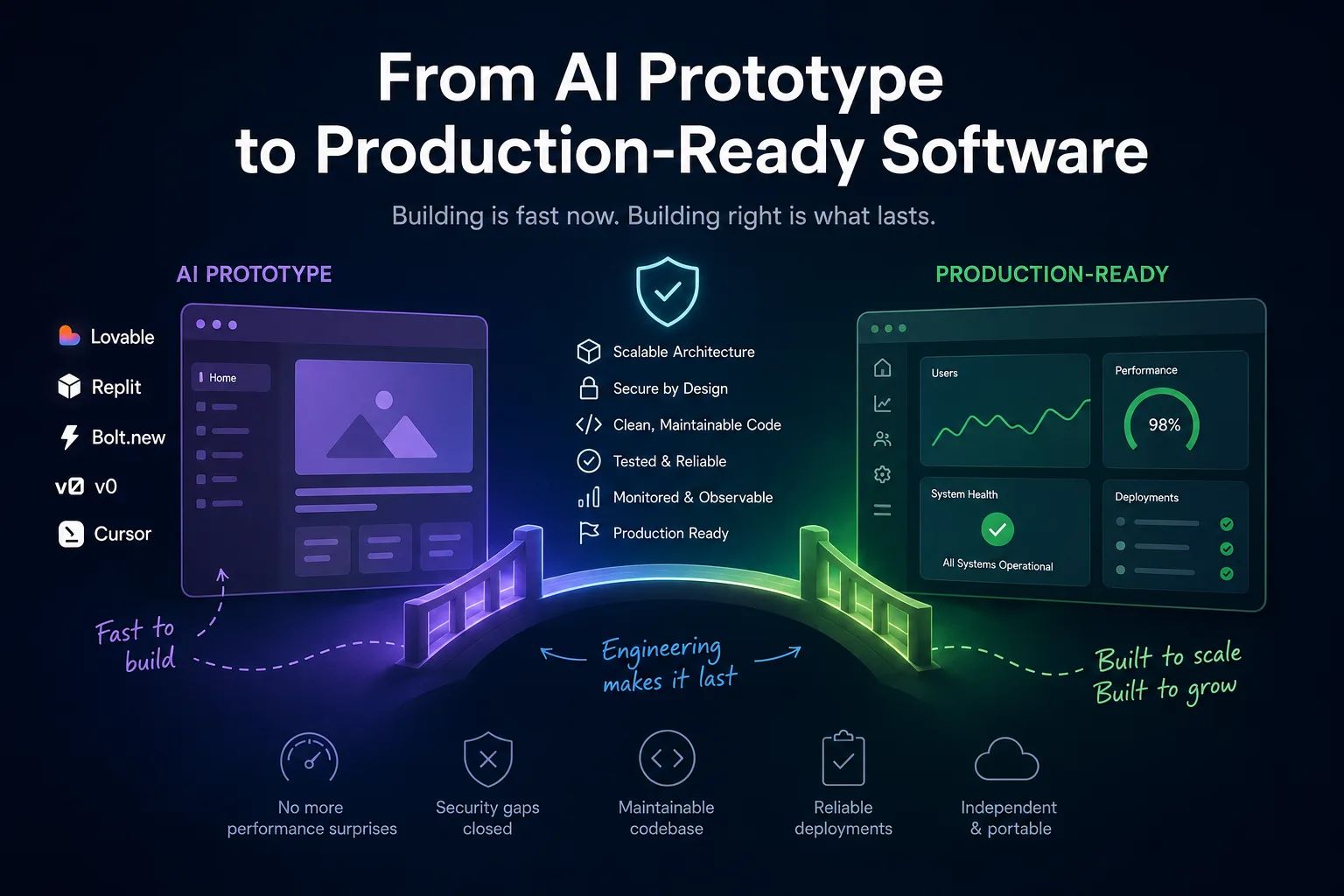
“It Works” Is Not the Same as “It’s Built Right”
A few years ago, if you had an idea for a software product, there was usually only one obvious next step: find a developer.
Today, that has changed.
You can open Claude, explain what you want to build, and within hours have something that looks surprisingly close to a real product. A landing page appears. Buttons work. Data gets saved. You can log in, click around, and show it to someone else.
And honestly, that's incredible.
For the first time, many business owners can turn an idea into something tangible without first assembling a development team.
But there is an important question that often gets missed:
Does working mean it's built right?
The doctor can see what the patient can't
Imagine two people walk into a doctor's office complaining about pain near their ear.
Both describe something similar. Maybe it's an ache. Maybe it's sharp. Maybe it spreads toward the jaw or temple.
To the patients, the symptoms feel almost identical.
But the doctor looks inside the ear.
One patient has an ear infection. The other has a nerve condition.
The symptoms overlap, but the cause, treatment, and risks are completely different.
The patient can't see that by simply feeling the pain. The doctor can see it because they know what to look for.
Software is surprisingly similar.
A business owner can look at an application and see that everything appears to work. A developer can look at exactly the same application and see a completely different picture.
The difference is what's happening underneath.
“It works” can hide a lot
Let's say a founder builds an internal application using Claude.
The application does exactly what they asked it to do. They can create an account, enter information, generate a report and delete a record.
For a small team, it might work perfectly.
But then the business grows.
Suddenly, 30 people become 300. A new integration is added. Customers start using the system. Payments are connected. More data is stored.
And that's when questions start appearing that weren't visible before.
Can the database handle the increased traffic? What happens when two users change the same record at the same time? What happens if a network connection disappears halfway through a request? Is sensitive information properly protected? Can the system recover if something fails?
These aren't necessarily problems you can see by clicking through the application.
That's what makes them dangerous.
A system can look perfectly healthy on the surface while carrying problems that only appear under pressure.
This doesn't mean you shouldn't use Claude
Quite the opposite.
For many situations, using AI yourself is probably the smartest first step.
If you have an idea and aren't sure whether anyone will use it, why spend months and a large budget building it before testing the idea?
Build a prototype.
If your company has a repetitive task that takes someone two hours every week, see whether AI can automate it.
If you need a simple internal tool, experiment.
AI has dramatically reduced the cost of trying things.
That's a huge advantage, and businesses should take advantage of it.
The mistake is not using AI.
The mistake is assuming that a prototype and a production system have the same requirements.
They don't.
The point where the game changes
There is a natural moment when a project moves from experimentation to infrastructure.
Maybe customers are now depending on it. Maybe you're processing payments. Maybe you're storing customer information. Maybe the application has become central to how your team operates.
At that point, “Can we make it work?” is no longer the most important question.
The question becomes:
“Can we depend on it?”
That's where an experienced developer brings something different to the table.
Not simply the ability to write code.
The real value is understanding how all the pieces fit together and thinking about what happens outside the happy path.
A developer is looking at the architecture, the security model, the database, integrations, error handling, scalability and maintainability. They're thinking about the problems that haven't happened yet.
And that perspective can save a business a lot of money.
The expensive part is usually not the first version
One of the biggest misunderstandings about AI-assisted development is that the initial build is the expensive part.
Often, it isn't.
The expensive part can come later.
A security problem can become a data breach. Poor architecture can turn a simple feature into weeks of development. Technical debt can make every future change slower and more expensive.
And sometimes the biggest cost is simply discovering too late that the foundation needs to be rebuilt.
It's similar to ignoring a small problem in a building because everything still looks fine from the outside. The longer you wait, the more expensive the repair can become.
That's why having an experienced developer review an AI-built application before it becomes business-critical can be incredibly valuable.
You don't necessarily need someone involved from day one.
But you should know when it's time to look underneath the hood.
AI changes the role of developers
I don't think the future of software is AI replacing developers.
I think it's developers using AI to become dramatically more productive.
AI can help with the repetitive parts of development. It can generate code, explore solutions, create prototypes and accelerate experimentation.
That gives developers more time to focus on the parts that require judgment.
Architecture.
Trade-offs.
Security.
Business logic.
Edge cases.
And the questions that aren't obvious from the original prompt.
The strongest teams won't be the ones that refuse to use AI.
They'll be the ones that know where to trust it, where to question it, and where human expertise needs to take over.
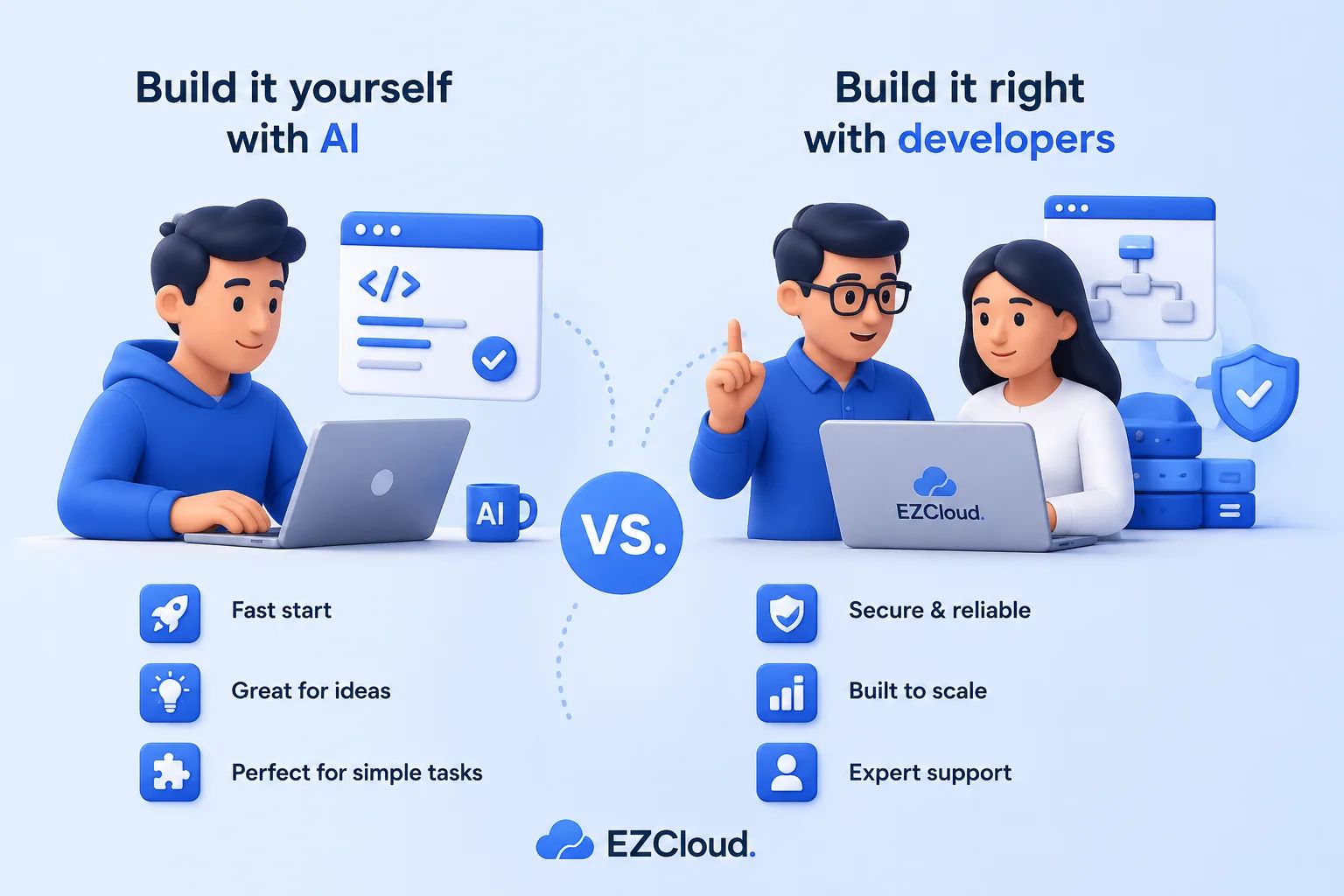
So, should you build it yourself?
Sometimes, absolutely.
If you're exploring an idea, use Claude. Build something. Learn from it. Find out whether your idea has potential before investing heavily.
But when the application becomes something your customers, employees or revenue depend on, treat it differently.
That's when you need to ask whether the software is not only functional, but secure, scalable and maintainable.
Because there are two very different statements:
“I built an app and it works.”
and
“We built a system that the business can depend on.”
AI can help you get to the first one incredibly quickly.
Getting to the second one still requires experience.
And ultimately, that's the part that matters.
AI can write the code. Humans still need to understand it, validate it, and take responsibility for what goes into production.
Just like in medicine, sometimes you can't understand the real problem by looking at the symptoms.
You have to look underneath.